Showing posts with label Musings from the Road. Show all posts

Tuesday, October 3, 2017

Rakhiv, Ukraine: Musings from the Road

”Musings from the Road” is any post where the content is not constrained by chronology. This gives me more freedom to write about whatever comes to my mind, though the content will almost always be influenced by the tour in some way.

The Plan

This one isn't so much a musing as a logistical update: I bought a plane ticket from Istanbul, Turkey to Addis Ababa, Ethiopia on November 2nd. Normally I'd just bike to Ethiopia... but if I did that, I wouldn't get there in time to meet up with Jacob, a cyclist who I meant to meet around November anyways, before both of our plans changed. This will also put me in Cape Town, South Africa, around next March, so I can fly back to Istanbul and continue my route through the Middle East. Going through the Middle East, especially the Pamir Mountains and the Himalayas, is inadvisable if not impossible in the winter, so “escaping” to Africa seems well due.

On the way to Istanbul I plan to visit Transylvania, including biking the Transfăgărășan, a stretch of highway running through the Carpathians, as windy and challenging a climb as it is beautiful. I'll also visit Greece – as much of it as I can see in the time I have.

PICK ME

Back in July when I decided not to go to Africa via Spain, I was relieved. I wasn't looking forward to doing Africa. Maybe the timing wasn't right, but my gut said “no.” Now, I can't wait. Especially after reading an article Jacob sent me on one of our possible routes, around Lake Turkana on the border of Kenya and Ethiopia.

The only downside is I'll likely need a new bike because Louisa will only take tires up to 35mm (1.37”) wide, and I'm guessing I'll need at least 1.5” if not 2” tires to make it through Africa without walking half the time. To be honest, Louisa is getting old anyways. It's sad but true: her drive-train and front wheel are due to be replaced, the brakes are difficult to adjust, and the shifters are getting feisty. It's my fault for putting together a bike with used parts. Though they are good touring parts meant to last thousands of miles – no doubt “forever” for the bike of someone living in one place – I've ridden well over 6,000 miles now and have at least 6,000 more to go. I suspect I can have all the work done for roughly the cost of a new bike in Istanbul anyways, so it seems a new bike would be well worth the cost. Louisa and I have some wonderful memories together and it will be sad to part, but it's been a good run.

Also I've started learning Swahili.


Privilege and Gratefulness

This tour has had me periodically thinking about how privileged I am. It's been dumped on me twice now:
- Once, after a host felt I was ungrateful towards them due to a terrible communication error on my behalf, they lamented how “easy” it must be to go from host to host, sleeping and eating “for free,” and that I should try working a day or two in my life. This isn't how I see my hosts, of course (an apology was most certainly in order), but it does highlight the privilege of being hosted: often, I do eat and sleep without paying money.

I do, happily and proudly, give my time, personality, and stories, and I think that's really the exchange most hosts are looking for. I did work hard (three years) to save up for this trip, but I am still privileged in that I got paid enough to have something to save – many people just get paid enough to afford the bare necessities, and never get to leave home, much less for months or a year at a time.

- I was talking to a host about my time in India, where I was “the white guy” working in a lower class bike shop under a subway station for free. One of my customers had complimented me on pursuing my passion (bicycle repair) despite the fact that many people in the US would never work under a subway in India and many Indians would strive to “advance beyond that.” But my host had a different perspective: what if he was thinking, “Look at this ungrateful idiot, who has so much he can afford to work here for free, and isn't taking advantage of it by living in a house on the beach?” In that instant, I became again grateful for having the ability to travel and do what I wanted without needing to do it for money.

But some of the privilege is a bit more subtle. The way some people look at me as I bike by them – the construction workers on the side of the road, the shepherds, the cashiers on a smoke break – is a desolate jealousness: look at thus guy, going where he wants. Most people are curious, but sometimes you can see in their faces a despondence: I will never have that. The eyes of one construction worker in particular spawned this realization, and I will never forget the way he looked at me.


”Cheap”

A lot of the time when I travel I quote costs and say “this country is cheap” or “this country is expensive.” While this is a valuable perspective to the traveler, I'm not sure it's a valuable perspective as an ethnologist. When I was nervously trying to figure out how to spend my time in Odessa I read an article along the lines of things to know before you go. I can't believe I didn't think of this before, but the article suggesting looking up the difference between what people make and what things cost. Because if a Snickers bar at $0.30 is cheap to me, someone from the US where the average income is about $55,000 a year, it might be expensive to someone from a country where the average income is only $8,000 per year. In fact, if I expect that Snickers bar to be $1 since that's what I'd pay in the US, that's 0.000018% of the average US income. At $0.30 on an $8k salary it's 0.000038%, so even though to me, $0.30 is cheap, it costs more than twice as much of the average income here (note: I pulled $8k/year out of the air, I have no idea what the average income is in Ukraine).

And to think, if something like a Snickers bar could be so important to someone that they'd spend x amount of their income, how hard it could be to get enough money to move from a poor country to a rich country? It might take two or three times as much work for someone here to make the money to move to the States than it would someone in the States. This hit me pretty hard – at a $55k salary, most people in the US can afford to fly from almost anywhere in the world to the US. But making a few cents a day, how long must to take to save the money?


Meaning, Culture, and Travel

There's no beating around the bush on this one: the US's number one export is culture. Sure, some products here are “designed in the US;” when in India in 2013, I saw apples imported from the US. But by far the greatest influence the US has is cultural. Las Vegas, LA, New York, and California t-shirts, inspirational quotes (in English), the American flag, and the desire to learn English (they sometimes have a “word of the day” on the news): all these things are prominent almost everywhere I go.

Unfortunately, it seems this drives a lot of consumerism. Marina and I talked about this a lot: people here want to be “cool” just as in the US. They buy what they see in the ads, and even if they don't speak English they wear English phrases and Western places on their shirts – much like some Americans wear Chinese characters on their clothing or have bags labeled with places they've never been to. I'm not judging but for me personally, I'd never buy something that costs more unless it's meaningful to me, and the words “Amsterdam” aren't super meaningful to me since I've never been there (yes, it's the bicycle capital of the world, and for that reason it's meaningful – but it could be I go there and it's not what I expect, and then suddenly, I don't really want that tattoo anymore...). I can't tell people what's meaningful to them and what isn't, but spending money to “be cool” to other people has never been my game (I acknowledge some people buy things with words they don't understand or places they've never been because it's meaningful to them – cool).

Consumerism also drives commercialism, which, in my opinion, ruins a lot of touring. I don't travel to buy things, I travel to experience things. This slapped me in the face when I saw some doves sitting in a line on a monument in Odessa. “Cool!” I thought, “this will make a nice shot.” I took out my camera and walked cautiously around them so not to scare them, looking for a good angle to take a picture. Just as I was kneeling down to take the photo, two guys walked over from a bench ten feet away, picked up the doves, and held them out to me. My heart sank and I felt a little betrayed – mostly, I admit, by my expectations. I knew immediately the doves were a tourist trap and these guys wanted money to take a photo.

I put away my camera and must have repeated the word “no” fifty times as they put a dove on my shoulder and my arm, outstretched to hold my jacket. “It's safe. See?” one said. That wasn't the problem – the problem was I didn't want to pay them. I assumed they wouldn't leave me alone because they thought they could trick me into giving them money, so I asked, “how much?” Quoted the price – 50 UAH, about $2 (a fair bit of money here) – I said “no” one last time, and finally, they took the doves and I was able to walk away, frustrated and upset. What I'd thought was a natural occurrence was just something staged for profit.

In retrospect, there's nothing wrong with that: you could argue any theater production is “staged for profit.” I think it hit me hard because it was unexpected. Doves on a fence are simple enough I was caught completely unawares by someone asking for money. I don't want to have to expect that everything I want to take a picture of will cost some amount of money.


To do

One thing I've been doing as I've been traveling is thinking about ways I want to live differently when I get back. Being so removed from both US culture and living in one place has afforded me a lot of clarity; it's also possibly afforded me a lot of naivety. We will see. In any case, here are some changes I'd like to make, maybe not permanently, but at least long enough to see if I enjoy the change. I'd like to make these changes as soon as I get back – from day one if possible – since putting off leads to more putting off. We'll see what happens. And, I'll likely update this list as the tour goes on, or at the least, when/if it ever ends.
Fewer video games: When I left the US I wasn't playing video games nearly as much as I did in my teens (sometimes 40 hours a week or more); in fact, sometimes I only “got on” once a week or less. I don't think video games are necessary bad, especially in moderation: I've made many good friends through video games, found them a great way to relieve stress, and depending on the game they can even have benefits to your mental health.

But, they eat time, and there are other things that I think would make be more meaningful, like reading, exercise, and being outside (all of which are on this list). I'm still undecided if I want to quit cold turkey. I have been daydreaming about two games in particular, both extremely difficult strategy games (Rome: Total War and X-Com: Enemy Unknown, for those wondering). But I'm worried if I “give in” to the urge when I get back, it will never end. Sometimes quitting things cold turkey is the best way to ensure you don't get addicted again. And honestly, while I miss them, I could certainly live without them. It would certainly help to use the time for other things, like all the ones I've listed below.

Rollerblading: This one actually came to me in a dream. I dreamt I was rollerblading down University Ave, a main street in Madison with a separated bike lane, while dancing and listening to music, wearing a custom, light-up vest that read: “Caution: Roller Dancing in Progress.” The more I think about it the closer I've come to the conclusion that rollerblading is the ideal sport for me: as much as I love bicycling, you can't really dance on a bike. Maybe there are skilled bicycle dancers out there, but I need the freedom to move my body without worrying about falling over or having such a (relatively) large turning radius.

I suspect this has been floating in my subconscious ever since a friend of mine, Sam W, showed me this awesome music video which is a one-cut video of three roller-dancers behind a car. A little research shows some of the other cool things you can do on rollerblades, though I think I'd want to pioneer roller-dancing a bit more (I've pitched partner roller-dancing to a friend who is in a dance troupe I'd like to join when I get back).

And of course (because I'm me) this will require appropriately colorful rollerblades and a helmet.

Exercising every day until I break a sweat: This is never something I've done before. I exercised often, sometimes many days in a row, but never for more than a few days or a week. This will likely require coming up with a mix of exercises, from bicycling, to rollerblading, to karate, to yoga (which I tried with my host in Philly and loved), and will get harder in the winter, but I think it will be worth it. It would be especially cool to live somewhere with wooden floors so I could dance every day (can be done on carpet, but not the same).

Eating more vegetables: Maybe I'll research salads until I find a bunch I like and eat a salad a day, maybe I'll cook more like we did on the Color Farm (steam squash every day), I don't know. My previous diet wasn't bad, but after having vegetables be the majority food in my diet at the Color Farm, I know how effective they can be at making me feel energetic and in a positive mood. The US (and indeed, many other cultures per my musing above) doesn't really prioritize vegetables, which is a shame, but I'm going to figure this one out anyways.

Writing more: As you're aware, I currently take time every week, or at least every few weeks, to write about everything that's happened in my life. This, of course, has surreptitiously labeled itself as “blogging.” And it's really incredibly therapeutic. Since getting to the Color Farm I also started writing privately a bit more (I had journaled some since starting the trip, but at my month on the Color Farm I easily doubled what I'd written in the past four months of touring). But blogging has sort of accidentally been my way of journaling, and I'm sure there's some research somewhere to indicate that's healthy for you. So somehow – maybe not publicly, but somehow – I'd like to continue journaling so thoroughly, reflectively, and deliberately on a regular basis.

More of the same: Objectively – disregarding my depression, that is – I had a great life in Madison. I was a little nonplussed about my job, but in my free time, I danced, took karate, spent time with people I loved, sewed, and... well, did many things (I'm a bit of a jack of all trades). I don't regret leaving it for the experiences I've gotten to have on the bike, but it would be silly to say I was going to completely change everything upon my return. I really hope some things are the same. I can't wait to spend a Saturday night at karaoke followed by dancing at Plan B followed by 2 AM burritos at Burrito Drive, or having Bad Movie Night, or putting all my friends in an assembly line to home-make tortellini for my birthday party, or pushing social bounds and breaking social folkways by asking uncommon questions or hugging people a bit too long or dancing or singing or climbing in public when I'm not supposed to. Yes... more of that, please.

Spending more time with people I love: This is really an “enough said.” This tour has solidified something I suspect I knew all along: relationships are the most important things in our lives. I want my actions and the way I spend my time to reflect that value. I've loved touring and meeting people from all over the world. But the things I'm looking forward to the most are choreographing a roller-dance with Mandy, talking about childrens' books with Jill, biking with Grace, eating at Sofia's with Dubby, drinking tea with Casey, dancing with Sam, going to karate with Adam, playing rolfball with Donovan, AJ, and Emma, hugging Andrew a bit too long... the list goes on.

Finding more people I love: The one thing this tour has changed most fundamentally about me so far is this: the knowledge that there are an inexhaustible number of incredible people out there in the world. I like to think I'm collecting them – that I can start a new country when I get back, Kyletopia, which has in it all the wonderful people I've met. At the least, maybe this country can temporarily exist during my wedding or my funeral (much like the scene in Big Fish when all the characters from his stories get together) – hopefully it won't take until my funeral.

My one wish at this point, the one thing I want to change the most, is my ability to meet and draw more incredible people into my life and keep them there. This is no doubt complicated by the competing priorities the US has between working hard, getting rich, and appearing “busy” and being “cool.” But those are complications I want to overcome. That, I think, will be my first priority upon return.

Thursday, August 17, 2017

Munich, Germany: Musings from the Road

”Musings from the Road” is any post where the content is not constrained by chronology. This gives me more freedom to write about whatever comes to my mind, though the content will almost always be influenced by the tour in some way.

Beer In a Hurricane

One of my friends sent out an e-mail after Hurricane Sandy. There were a few motifs, but one was being aware that what makes other people happy might not make you happy:

If you see someone buying an xbox with their tax refund or saved tip money, after they've used food stamps for dinner, and that seems unreasonable, just remember I bought a roast and a case of beer during a hurricane.

Recently I had to buy another rear wheel. I was hoping to get something used for around $20-40, but in the end got a new wheel for about $100. I also got a new tire (since the old one had a hole in it from the old wheel exploding) and a new seat (since the old one had broken back in England), also both things I could have gotten used. In fact, I don't think I've ever owned a new bike seat before – except once when I bought a new bike, except that bike was an unsold model from 2 years ago, so it wasn't exactly new... and I ended up not using that seat anyways since bike seats are as personal as favorite coffee mugs.

In any case, someone had recently donated an amount that came to roughly the sum of these purchases with the note, “Life doesn't always come with tailwinds.” As I was riding my bike to the community bike shop to swap the cassette, my old wheel blew. BLEW. With a bang.


I had to walk the rest of the way (only 3 blocks, not bad). And I was like, “No life does effing not always come with tailwinds.” So while this person didn't specifically say, “Go buy yourself a new wheel,” it seemed fitting that the amount they donated was the same as the amount I spent and they had effectively saved me from being without a rear wheel. Yet I had it in the back of my mind that, I could have gotten a used wheel, a used tire, a used seat... those may not have lasted as long, but I would have saved money.

Ultimately, I'm okay with having bought new. I'm usually opposed to this – most of us don't really need new things (for instance, the cost-per-useful-mile of buying a used car is often immensely less than that of a new one, and don't even get me started on environmental impact)... but often, new items do last longer, and on tour, you want things to last as long as possible. Even if I quit in India next year, halfway around the world, that's still another 5000 miles. I hope this donor would be okay with that, but if not... maybe a new wheel is my beer-in-a-hurricane?


On a side note, I built the wheel that broke, and it lasted over 12,000 miles and failed because of wear, not construction. I never had to replace a spoke and it rarely needed truing. I'm pretty proud of that.


Compassion Under Pressure

A quote I try to live by is this: “Darkness cannot drive out darkness. Only light can do that. Hate cannot drive out hate. Only love can do that” (Martin Luther King). I spend a lot of time thinking about this on tour. How can I show compassion to people who are less-than-polite? Most people are immensely kind, of course, but every now and then you meet someone who is just having a bad day, and I don't think being rude to them in return makes their day any better.

Back in the States I had a stay with a host and I kept moving the date around. First I'd overshot the date, then something went wrong. By the time I showed up I'd changed the date three times. Their review of me? “Kyle was very communicative about his arrival date.”

I was baffled. I was expecting, “Kyle kept moving the date around and it was really annoying.” And that would have been fair!

Once I was at a stoplight going straight, the light turned green for left turners, and somebody honked. I hadn't gotten much sleep the night before so I was a bit grumpy: I turned and made eye contact with the car behind me and said, “I'm going straight!” I assumed they were honking at me. The car next to them (in the left turn lane) said, “It's me, dude. I'm going straight from the left turn lane.”

“Oh,” I said. Then, “You can go in front of me if you want.”

I felt bad for getting grumpy for no reason. Yea, I was tired. But on a bike, getting grumpy at drivers is dangerous. More, it was just unnecessary. I want to be compassionate and patient even when tired – even when grumpy. Apparently, I have some work to do.


Caught Camping

I mentioned earlier that I was caught camping for the second time, but I never wrote about the first. Here it goes, then.


I had camped the previous night in a beautiful spot on an unused field (above), so I was feeling ambitious about finding yet another beautiful spot. I did, but there was a caveat: the only flat spots were either with a view of the ocean from my tent and a view of my tent from the road, or no views at all. Since England has hedge rows everywhere, the only way anyone would see me from the road would be if they walked by and turned and looked for me. I figured, what are the chances?

Well, it wasn't two hours later I was reading my book and heard footsteps. I looked up and the owner of the field was staring incredulously at me. He started to walk over but I, knowing it's always better to be proactive, stuck my head out of the tent and said hello.

”Were you planning to pay?” he said, still incredulous.

“How much would you like?” I said, completely honestly. I was (evidently) on his property, and I had my tent set up and was willing to pay not to have to take it down and move elsewhere. I would move, of course... I just didn't want to.

“There's a campsite down the road, it's quite cheap, really!”

Not wanting to argue with him about how that campsite was full of camper vans and being the only tent sucks because nobody realizes how noisy camper vans are when they are in one, I offered again: “How much would you like?”

“If you would've asked I would have said yes!”

“I didn't know who to ask,” I said, honestly. I wasn't even sure where he'd walked from, there were only barns nearby which had been empty when I'd come in.

“As long as you're gone in the morning, I'll let you stay,” he said, and stammered off.

I'll fully admit my ambition got the better of me here. I was happy to have gotten permission to stay there, but felt bad that I had made someone angry. It is never my intention to make people feel taken advantage of, and I hope that after he cooled off he thought maybe I needed a place to stay that wasn't covered in camper vans and he had done me a favor at no cost to him (he did). But ultimately I know stealth camping comes with a risk of being found. I should have gone with the spot that didn't have a view of the ocean and couldn't have been seen from the road; since I got caught, I just tried to be as humble as possible.


Shotgun Edition - Lots of anecdotes that don't fit anywhere else

1. In Europe, you now have to verify your ID to buy a SIM card, because terrorists have been using them as throwaway methods of communication. My current host gave me a SIM card he had lying around, but only after he was on the phone with someone using his camera to take pictures of my ID.

2. Switzerland is expensive. I tried to buy as little as possible there. They even use their own currency so it's hard to know how much you're spending. My current host has heard stories of people paying what ends up being $8 for a coffee. In Germany they call this being “Switzerlanded.”

I had to call my Swiss friends while I was there but I was still on my French SIM card. Not wanting to spend 1E/minute, I used a payphone. The display read 0.10E/minute.

A $51.50 charge has posted to my account.

Switzerlanded.

(yes I am contesting it, the call was only 3 minutes!)

3. Are we obliged to gush about people who are kind to us? In the age of five-star reviews, more and more companies and people get angry or insistent if you don't tell them they are amazing. Why isn't a four-star experience acceptable? What if something was imperfect but I still had a great time? When I stay with hosts that are a little messy, or have a smelly refrigerator (pulling these examples out of thin air, by they way, they aren't actual feedbacks for anyone in particular), I don't really care – but someone else down the line might. Should I write an objective review? Is it possible to communicate I had a five star experience even if there was street noise all night? If the host explodes in rage that I didn't profusely congratulate them on their imminent perfection, does that say more about me or more about them?

For my two cents, honesty and humbleness are some of the most underrated and underused tools we have. Accepting criticism with grace and still knowing you're awesome, that it's okay to get 99/100 and that one or two pieces of negative feedback doesn't mean you're 0/100, is something we all should be working on.

4. This is my life now. It's finally settled in. I live without a static home, moving from place to place, sometimes meeting people and sometimes sleeping where I can. It no longer feels temporary, like something that will end any day now. It's just my lifestyle. There are ups and downs, like life. There are easy days and hard days.

This is my life.


Happiness: Tim Kreider Edition

I talk a lot about happiness and how it's not something you can chase or grow or produce. It's a byproduct, best enjoyed when it decides to show up and more likely to return the more gracefully you let it go. I love Tim Kreider as an author, and recently rediscovered an excerpt of his that I very much like on this subject. I thought I'd share it. The build up is about 2 pages, and it's all beautiful and I find it all to be true, but in order not to plagiarize I've selected only the conclusion.
Perhaps the reason we so often experience happiness only in hindsight, and that chasing it is such a fool’s errand, is that happiness isn’t a goal in itself but is only an aftereffect. It’s the consequence of having lived in the way that we’re supposed to – by which I don’t mean ethically correctly so much as just consciously, fully engaged in the business of living. In this respect it resembles averted vision, a phenomena familiar to backyard astronomers whereby, in order to pick out a very faint star, you have to let your gaze drift casually to the space just next to it; if you look directly at it, it vanishes. And it’s also true, come to think of it, that the only stars we ever see are not the “real” stars, those cataclysms taking place in the present, but always only the light of the untouchable past.

The book is called We Learn Nothing and I recommend it to everyone, if only for the occasional artistic bits about life's truths like the one above.

Saturday, August 12, 2017

Lindau, Germany: Musings from the Road

”Musings from the Road” is any post where the content is not constrained by chronology. This gives me more freedom to write about whatever comes to my mind, though the content will almost always be influenced by the tour in some way.

On Public Places to Stay

There is no hiding where this one is going: I believe that everybody has the right to a place to sleep. The kicker? Sleep should be free.

This does not mean a “fancy” free place to sleep – I am not saying, obviously, that hotels should be free or that anyone can walk into your house and use the spare bedroom. Just somewhere. The logical counterargument is that one needs property to sleep and property isn't free, so how can a place to sleep be free?

I don't know. Whether the way we distribute property makes sense is another argument entirely (I got here first! It's mine and I'm not native American!), but since I don't want to go there (I suspect the status quo is impossible to change; it is imperfect, but so widely subscribed to...), let me simply muse.

This trip is only possible because I stealth camp. I never leave trash behind and I never destroy property – I live by “leave no trace.” And if someone were to find me and ask me to leave, I would. I simply cannot afford to travel the world staying in hotels every night. Countless people, mostly hosts on Warmshowers but sometimes complete strangers, have taken me in and given me a shower and a bed, or just permission to camp in their yard or garage or shed from time to time. I am privileged to experience this; it's not something I ask for or expect every night nor would it be reasonable to ask for or expect every night.

But stealth camping is, 99% of the time, illegal. There are fortuitous places (some public property in the rural States; Scotland) where it is legal. We've made it really hard for people to sleep without paying. I have found the occasional shed or roof when the weather calls for it, though I often wonder if I was found, whether measures would be put in to prevent others from sleeping there again (most poignantly, I recall a shed behind an empty fire station I slept in when there was a thunderstorm coming in. After an hour, I heard people outside, opened the door, introduced myself, and asked permission to stay. The answer was yes, but I often wonder if the shed has since been locked).

Obviously I plan to host other cycle tourists when this tour is over. But would I let a homeless person sleep in my yard for a night? Aren't cycle tourists, on some level, just mobile homeless people? What if someone homeless asked me, “Hey, I've got a job interview tomorrow. I could really use a shower and a good night's sleep. Can you help me out?”

One of my hosts once unknowingly hosted someone abusing the system – an ex-con pretending he was on a bicycle tour in order to get free food and places to sleep. When the host figured this out, they were at first embarrassed. But when they told me this story, they laughed about it. “Who cares?” they said. “Guy got a shower, meal, and a good night's rest. Hope it helped him find a job.” I was grateful they were humble enough it didn't keep them from hosting again – too often one bad egg spoils the lot.

It's hard to get really far into this without getting political, so though it may seem unfinished, I'll leave it here as food for thought. It's a conversation better had with readily available statistics, too (eg, how many people “abuse the system?”). But I think about it often: how can we continue to provide affordable travel like bicycle touring? Or, is travel destined to be an activity only for the bourgeoisie? And at the most basic level – should we have to pay someone every time we close our eyes, a need as basic as water?


Comme tu veux

It was with great sadness that I left France and the French-speaking part of Switzerland. But there are many things about French (the language and the culture) that I liked very much. My favorite is the phrase “comme tu veux,” which translates to “as you like.” This was said to me by almost every host I had and then some. I like it because it sidesteps the dance of what's alright and what's not, putting the responsibility for the decision squarely in the hands of the guest. Here are the options for dinner – choose as you like. You can stay later: as you like. There is no pretext of “actually I really want you to pick A even though I offered B.” It's refreshing and simple and has forced me to be more decisive in the best way.

“Ca marche?” (pronounced “sah marsh”) also needs a shout-out. Translating to “That walks?” it's the English equivalent of “Ok?” or “does that work?” But like... with style. Ca marche? Ca marche.


McDonald's

A dilemma often faced when traveling is whether to choose what's reliable and familiar or whether to explore the unknown. I reference often in my blog looking for and finding McDonald's restaurants. How American! But actually, I don't like the food here very much, and I'm acutely aware how unhealthy it is for you. It's just... McDonald's almost always has free internet (I found one once that did not).

On tour, as in life, you have certain basic needs: food, water, a bathroom and a place to sleep. Sometimes, a roof (even not as a place to sleep – just to warm up, perhaps). I don't think internet is technically a “need” (I've been seriously considering living without it when I get back to the States) but it sure is nice to have: Hi mom, I'm alive! And it can lead to the other needs – for instance, you can use internet to find a Warmshowers host.

And when you're in a strange country it's nice to know where to get these things.

I've long been considering making a video about why shopping at non-local stores (and paying via credit card) is bad for the economy (I probably would have made it already except my travel laptop doesn't have the processing power, and I don't have the time). I guess when traveling though, especially in places where I don't speak the language, it's nice not to have to “seek out” the local grocery store, internet cafe, whatever. I want what's reliable. I want what's convenient – because so many other aspects of bicycle travel are, often, inconvenient. I get to sample the local cuisine at other times.

But I'm still acutely aware that I could be traveling differently.


Finances!

I actually wrote this musing when on the ferry from Wales to Ireland, but then my computer crashed and I lost it. So, let's try again.

I'm a numbers guy – I love to know how much things cost. I also think other people are curious: how affordable is bicycle travel? Maybe you donated and are wondering how far your donation went, maybe you want to know where I got “all that money” (a question often asked when I say I'm “traveling the world” and might be gone “at least a year” which should naturally cost tens of thousands of dollars, right!?), maybe you're planning your own tour and want a baseline. So, while I budgeted $20/day, here's where I actually stand for April, May, and June:
- Number of days on tour: Call it 90 (three months)
- Total amount spent: $2,823, $31/day
- Amount spent on “daily” expenses (mostly food, but anything under $50): $965, $10/day
- Amount spent on “big” expenses (health insurance, plane tickets, bike parts): $1858, $21/day

These numbers are probably plus or minus 10% because I had to combine information from two accounts (my debit card and credit card) and various statement periods (credit cards, bless them, don't always start or end on the first or last of the month). If I come back in a year and the numbers are different, don't be surprised.

So I'm doing really good – better then I expected, actually. I know, I know: $31/day! Over budget! Except... not really.

I (hopefully) won't have to buy a plane ticket again until I get to the Pacific Ocean. I'm not currently paying for health insurance (thanks EU!) and when I do buy it again, it will cost about half as much as I was paying in the States. So the “big” expenses are heavily front-loaded and will get more absorbed the longer I'm on tour. Consider what the next 90 days might look like:
- Continue to spend $10/day on “daily” expenses: $900
- Spend only $500 on “big” expenses
- Cost per day over those 90 days: $15
- New cost per day over the whole trip (($2823+$900+$400)/180 days): $22

Frankly, I expect to beat even that, since I aim to spend nearly nothing when WWOOFing in Ukraine for 30 days (I'll get room and board in exchange for work).

Again, I'm sure these numbers are not 100% accurate, but that's more or less where I stand. So no: I'm not super rich (by some standards... I fully acknowledge $3k goes very, very far in some countries) and I'm not living glamorously ($10/day + health insurance and a plane ticket?). I did live pretty bare bones to save up “all that money” (no car for three years, small apartment, lots of oatmeal and rice), but the point is, you don't have to spend thousands to see the world if you're willing to live in a tent. Also, if you want me to do a post on how easy it is to live without a car and the ridiculous amount of money you'd save, let me know... I'm pretty sure I could write that in my sleep.

You can also see how even one or two hotel rooms would wreak havoc – staying one night in a $100 hotel is 5 days of living expenses!

And if you donated – we know now that every postcard gets me another day of living expenses (food). Thank you!

Thursday, July 27, 2017

Perpignan, France: Musings from the Road

”Musings from the Road” is any post where the content is not constrained by chronology. This gives me more freedom to write about whatever comes to my mind, though the content will almost always be influenced by the tour in some way.


Hospitality: French Edition

This must be the... third time I've revisited hospitality? Yep. It's a theme. Surprise!

I received some feedback from a host in England that I did a few rude things – asking for more food at dinner, asking to buy a roll of toilet paper from them, putting my feet up (literally), and not spending enough time with them. I thanked them for their feedback, and I've been sitting on it since. At the same time as I received that feedback via e-mail, I was also told by a (French) Warmshowers host in person that it was rude not to ask for more! This was perplexing.

On the toilet paper – it seemed to me an innocent enough request. It's not technically a necessity (one can do things the Indian way, which I did while in India and found it to be just fine), but it's a very nice-to-have, and it's impossible to buy just one roll, so unless you can get a roll from someone you usually end up carrying around a 6-pack for your entire tour. This is not a justification of my question, just an explanation for those who haven't had to use the "loo on the road" before.

I digress.

The above is simply me stating the facts of the feedback I got, because, well, it's interesting. I'm not saying I did something right or wrong, though I certainly don't want to offend anyone whenever possible. I've resolved not to ask if there's more food if there isn't more food actually on the table, which I think covers the scenarios in which asking for more has been received negatively (the host in England, and once, five years ago, with a host in Guatemala when I was volunteering as a bike mechanic). I won't put my feet up unless I ask or see my host do it; while I'm still sensitive about how much time I spend with my host and by myself at my host's house, it remains important to me to catch up with friends on the rare occasions I have internet. So, the balancing act continues. At the end of the day, I strive to be an excellent guest; also, I make mistakes.

And now, in France, things are even harder, because sometimes I just don't understand what's going on. As I'm currently staying with a non-English-speaking family, there's a lot of clarification, and still sometimes the occasional misunderstanding. For the day today I knew my host would leave at 6 to go see a friend, and she asked if I wanted to go for a walk at that time. I thought she was indicating I needed to go for a walk – to leave the house when she was out, which would of course be fine, and is a reasonable ask, since leaving someone you've known less than 24 hours in your house alone might make some uncomfortable (though notably, I've only had one host in all my tours that has felt that way, and honestly, how would I steal your TV? On my bike?).

But then 4:00 came around (not 6), and she asked if I wanted to go for my walk, and I said OK, and then she said I didn't have to leave just yet... and I could stay there?

Oh god, if I mistranslated that, did I mistranslate whether I could stay for lunch tomorrow?

Which leads me to...


Learning French

Traveling with Francois was awesome in many ways, and I'll visit the non-lingual ones in a minute. Language-wise, though, it was a treat – he could communicate fluently with everyone we met, including store owners, the guy whose barn we slept in, etc. I can communicate well with people, but my conversations are very limited. To give you an idea, in English we might say, "How are you?" But we also might say, "What's up?" or "How's it hanging?" or "How's it going?" or... or... -- there are probably hundreds of ways to say the same thing. In French I know the equivalent of "How are you?" So when someone uses one of the other ways of saying something I know how to say, often the conversation drops dead. This goes for "How are you?" as well as logistical questions and conversational questions and getting-to-know you questions. But with Francois the conversation never drops dead. No opportunities are missed – that I know of.

Anytime I want something translated, I can ask. What's that sign mean? Francois will tell me. What was that conversation about? Francois will tell me. I don't ask for every word, of course – that would be obnoxious. I just try and pick out the key words I don't understand.

My comprehension has gotten to the point where I can pick out almost every word in a conversation: Instead of jevaisallerchezmonami I hear "Je vais aller chez mon ami." Of course, even if I can translate each of those words individually, that doesn't mean I understand the sentence (if I said, in English, "the quick brown fox jumps over the lazy dog," you might know the words quick, brown, fox, etc... but you might not be able to picture a quick brown fox jumping over a lazy dog. What does it mean?). This is, it seems, the next step in learning French. I can pick out the words – now I have to put them together.

The result is that sometimes Francois will ask me a question and I'll stare back blankly. I prefer this, though. I don't want to be babied. 50% of the time I can reply comprehensively! The other 50% I can usually asked a clarification question before responding.

But, I am far from fluent.

I will never again judge someone who doesn't speak English for not knowing what's going on. Other languages are hard. HARD. And I probably want my kids to grow up in a biligual household. The earlier they become fluent in a second language, the better. Not knowing what's going on sucks, and no matter how well intentioned I am or how hard I try, sometimes I just don't get it.

Sometimes I lean back and listen and that's okay – I can take a break for a bit and Francois does the talking. And I get to try wine as a result.

Sometimes people don't give me time to think – I might understand "Do you want a snack?" and know how to reply in either direction, but I just don't know if I want a snack. If anything, the implied time constraint and my limited vocabluary force me to be more decisive, which I don't think is necessarily a bad thing (quick decision making skills, I think, might be a cultural norm of southern France. Francois said he noticed this too, at the market).

Without Francois, I am getting better at asking how to say something (asking, in French, how to say something, in French). Sometimes it's easy – "The person who drives a car is a driver, what's the person who drives a plane?" Somtimes it's hard – "Okay, so, I see that food, and I think it's good. How do I say that?" (hoping for the translation of "it looks good." This one ended up needing a dictionary). Just today I also discovered TV – watching TV in a target language is a great way to learn words. AND it's a great way to spend time with your hosts. Maybe you'll discover an awesome show about a guy who rides trains to random places and talks to the people he meets? Maybe it'll be called The Train Unlike Any Other? Who knows...

There's also the vous/tu game – formal vs informal "you." Thibault, our host in the Pyrenees, referred to me as "tu" right off the bat, and I received a friendly chastising when I said "s'il vous plais," the formal "please," instead of "s'il te plais," the informal "please." I'm with a host now that's still using "vous:" I'm in their guest bedroom, we've shared meals, and I'm pretty sure I'd call them my friend? Maybe it's a regional thing, maybe it's a "raised right" thing, maybe they are playing it better safe than sorry, maybe they are using "vous" because I'm using vous... agh. Language!

(maybe I'll ask them about it tomorrow morning and hope it's not a rude thing to ask)


Traveling with Two

Not too long ago I lamented not being able to buy the rediculously cheap bottles of wine that are here in France. Well, Francois and I celebrated our first night together by splitting a bottle of cider – albeit 2% cider. And much wine was had over the course of the next week.

I haven't traveled with anyone else since the end of my last tour. I forgot how rediculously moralizing it could be to have someone to laugh with, talk to, plan with, share a meal with. Humans are social creatures, and just having someone in your "tribe" can be an immense morale boost, even if you aren't talking all the time. I think at the top of the col after being sold the wrong tire, I would have cried instead of smiled had I been alone.

There are downsides, of course. You often have to wait for each other. You have to compromise on where to sleep and how far to go. If just one bike breaks, you're both stuck waiting. Francois had a lot of mechanical trouble. Not his fault! I don't blame him and I have no negative feelings towards him. But was I a less patient person I could see that having been a falling out point. He was also the navigator, meaning I was subject to him telling me where we were going – wrong turns? Not his fault, no; again, though, without patience and humility, it would be easy to become frustrated.

I'm really, incredibly glad and grateful I met Francois and I hope we get to see each other again – maybe we'll even ride together again. It was a nice reminder that riding with someone is better than riding without someone. It was nice to have a friend.


Homesick

My last tour came out to 72 days. As of today I've been vagabonding for 106 days. That's a record for me. I have had temporary homes – a friend in Madison let me stay with her for a really wonderful week. My sister let me stay with her for a week. A few hosts have let me take "break days" at their houses. But for the most part – for at least 85 days – I've slept in a new place every night.

I miss having a home.

A home provides so many benefits that I will never again take for granted. The most important, I think, is the feeling that you belong. I didn't realize this was so important to me. Knowing I have people I can talk to, rely on, lean on, knowing where I'm going to shop for groceries and sleep at night – that has become invaluable. It's not necessary, of course. But it is so, so nice.

A home is also a place to recharge. You can go there and do you and not worry about other people putting restrictions on it. Who cares what other people think, sure, but if you are in someone else's house you might not be able to put your feet up (literally or metaphorically) or decide when to eat or when to shower or where to sit or if those blinds are open or closed. You don't have to ask anyone permission to do anything (except maybe a landlord if you want to blow holes in the wall).

I have received nothing but kindness during my stays (even the guy who asked five times that we not smoke in his barn was kind enough to let us sleep in his barn) for which I am rediculously grateful. I want to return that kindness to my hosts and I know that for most people, the best way to do so is to spend time with them and share myself with them and let them share themselves with me. But I miss having a place I can go and lie on the floor and sleep on the floor if I want and not have to worry about the police asking me to move along or if I've been polite enough to my host (which of course I want to be). I need a space to ponder the mysteries of life and not worry about whether I'm in anyone's way. Sometimes I get lucky with a picnic spot... but often I find myself yearning for my old apartment, except not really because it had some anxiety triggers.

If I am lucky, I'll get to spend the first two weeks of September working at a vineyard in Champaign. I also have a month planned at a farm in Ukraine, which I'm looking forward to almost a rediculous amount. If I could do this tour again I think I'd plan even more of these, maybe even using biking as the inbetween instead of the method of living. Maybe these stays will change my perspective, but for now, my bucket list contains as many settle-down-again things as it does travel-there-too things. I'd get to sew, and have an accordion, and know when and where dancing is.

I discussed this once with a host who let me "put my feet up," metaphorically and literally. She had experienced the same thing in her travels – "Even if you are there a month," she said, "it's not home. It doesn't smell like you. You live there, but you know it's not yours." This was also one of two people who has responded to my overflowing gratitude simply by saying, "I know."

I often try to elaborate on how grateful I am to my hosts. It's easy enough to say "thank you;" anyone can do it. But I am really, truly grateful, and I want to make sure people know, so I usually try and spell it out. Some people just smile and say, "You're welcome." But two people, both of whom had once vagabonded for extended periods of time, just said, "I know." We have shared the homeless struggle. Not the struggle of lacking a physical home, but the struggle of belonging. The struggle of having a place to put your feet up. They know how grateful I am to have that place of belonging because they, too, were once looking for it.

I say on my home page that I want to bike around the world as a medium to connect with others. I am doing that, and often, I love it. But I am also struggling to care for my own mental needs. At the end of the day, I am the only person that can do that. For now it seems the end result of this trip will be a good story; ultimately, though, the other goals listed ("through vulnerability and compassion, connect with each other and find purpose and meaning in what we do") might get achieved in another way.

So currently, the plan is to bike until the middle of next year, then come home and go to graduate school next fall, for which I have a deferral. The middle of next year I'll be in... the Middle East? India? Time will tell.

Maybe things will change and I'll decide to take the time to go all the way around... maybe I'll do it later? I don't know. I still stand by my last musing that the ideal situation would be a community of people traveling around the world together – anywhere from 30-300 cyclists, perhaps – but being that's very unlikely, I think it's reasonable to come home for a while and see what's changed. After all, the world isn't going anywhere.

Truthfully, I think in the end the happiest people find meaning where they are. I wouldn't say that I've gone out looking for a purpose or a meaning, but if, while traveling, I'm always musing about what it would be like to feel I belong somewhere, isn't the logical conclusion that I should stay in one place for a while? I find value in connecting with people. Maybe it's easier to connect with people when you sleep in a new place every night, but I think there will always be more people to meet, more to see, more of the world to explore. If you are always looking for what's around the bend, are you ever happy with what you have?

Wednesday, June 21, 2017

Glynneath, Wales: Musings from the Road

”Musings from the Road” is any post where the content is not constrained by chronology. This gives me more freedom to write about whatever comes to my mind, though the content will almost always be influenced by the tour in some way.


Travel begets travel

Often, a funny thing happens when you travel: you're given reason to travel more. When I was headed to London everyone said, “Go to Cornwall.” On the way to Cornwall, many people I met had suggestions for other things to do (perhaps curiously -- and I didn't remember it existed until it would have been a ways backwards to visit it -- nobody said anything about Stonehenge). When I was with Shaun and Dani in Dawlish, saying I had a day to get to Plymouth, Shaun said I really needed three – and indeed, while going through Dartmoor was beautiful, I didn't see any of that coastline (not the Cornwall coast). Once in Plymouth, my host Ian informed me that if I visit Scotland in the summer I'll get eaten alive by midges, which are small enough to get through mosquito netting, and require netting of their own that is more or less the fineness of a stocking.

I was originally going to swing back around to London and Scotland, having two people to visit that way, but in the interest of time (making it to Africa eventually...) I'm going to have to come back for them, and for London, and for Scotland. Maybe I'll do Europe: round 2 after going around Africa? We'll see...

It's heartbreaking to think of all the people out there I will never meet; but, it's heartwarming to know they are out there. If the sampling of people I have met is an accurate sample of the rest of the world, then there are hundreds, probably thousands of places I could go and feel like I belong. Because yes, the landscapes are beautiful, the history is rich, and the adrenaline of getting to everything by your own power is an enviable high. But the people are really what make you feel like you belong.

So the problem is doubled, then: there are the places you hear of when you visit the places you go, and there are the places you go that you then want to go back to. You can bet when I was cycling the north coast of Cornwall it crossed my mind to go across the peninsula and revisit Dani and Shaun in Dawlish.


That's Alright Then, or, British English

England's primary language is English, but it's British English. This doesn't just mean speaking with a British accent, it also means some different words and phrases. The one that caught me the most off guard was “that's alright then” instead of “you're welcome” or just as a conversion closer. For the British English speakers out there, saying “that's alright” in the US might be considered passive aggressive. So for my first week in England I was wondering how I managed to offend everybody. One conversation in particular got a little out of hand:

British dude: “Good morning.”
Me: “Good morning.”
British dude: “That's alright then.”
(pause), me: “Um... can I help you?”
British dude, over loud traffic: “I just said good morning.”
Me: “What?”
British dude, yelling: “I said, GOOD MORNING!”
Me, timidly, “Okay, good morning.”
British dude: “That's alright.”

Here are some other noteworthy differences (British English on the left, American English on the right):
- Bubble and squeak = Leftovers.
- Pastie (pronounced “past-ee,” “paste-ees” are something you wear on your chest) = Meat calzone, sort of like farmer's pie... but shaped like a calzone... but a pastie.
- Cream tea = Tea, scones, jam, and clotted cream. If you're in Cornwall, the jam goes on first; if in Devon, the cream goes on first (one of my hosts explained this to me and, upon stating the opposite of what he does, he said that “just seems wrong.” There is even a story about this that will go on the map at some point).
- Clotted cream = The fattiest part of the milk skimmed off the top.
“That's alright then” or “Thank you” = You're welcome (yes, this means when you say “thank you” the reply is sometimes “thank you”).
- Rosette = Ribbon (an award for placing in an event).
- Route (way to get somewhere) = route, but in British English it's pronounced “root;” a “ra-out” is the first part of the word “router,” the tool used to engrave wood.
- Cycle track = Bike path or bike route.
- Boot (Shaun: “Our caravan's small enough we just put it in the boot”) = Trunk (of a car).
- Caravan = Mobile home.
- “Course you can” = Response to “can I please have...” (eg when ordering food or a product behind a counter).
- Mudguards = Fenders.
- “Can I use the tap in the loo?” = “Can I use the sink in the bathroom?”


Hospitality and Invisible Rules

I've been doing a lot of thinking on this trip about when it's appropriate to ask someone for help and what it means to be a good guest. It would be sweet to stay with someone every night, of course, but that feels... dirty? I am capable of camping and I don't want to take advantage of people. I stay with people primarily to get to know them, because touring by myself without ever spending time with anyone would get quite lonely, and because people are awesome and part of the point of this trip is to prove to myself and anyone who cares to listen that complete strangers from other countries really aren't that scary. As a secondary reason, if I need a shower and someone is willing to give me one, I just saved $50-200 over a motel/hotel. Often my host enthusiastically cooks, cleans, etc. on my behalf (last night I camped in someone's field; an hour after “Thanks, see you in the morning” they walked out with a beer, a sandwich, and chips, concerned that I looked “a little skinny”), but I am more than willing to cook, do the dishes, and make and strip the bed to save that cost.

My conclusion thus far is that there isn't a one-size-fits-all rule, either in the sense of the person touring, the tour they are on, or the country they are touring through. I stayed with people just under 1/2 the time in the US, though almost every stay with a Warmshowers host was instigated all or in part by weather. I can camp in the rain, it's just... annoying. Not to mention after a day of pedaling in the rain a warm shower and a bed are that much more morale-raising. Despite being instigated by weather (there was one last-minute call after a forecast change where all I asked for was a roof over my head, specifically stating that the garage would do), there isn't a single host I spent less than an hour or two getting to know.

I've been in Europe 13 nights and spent 5 indoors; the rest have either been stealth camping or camping with permission (“Can I put my tent in your yard for one night/do you own a field nearby?”). I expected to spend only 3 of those 5 indoor nights indoors; the other two, I was invited in without asking. It's felt about right.

For a while, staying with people made me a little nervous. I had a stay with one host that more or less exploded in my face when I wrote about it on my blog. I won't get into details for the purposes of privacy, but suffice to say I didn't feel I did anything wrong during my stay, yet I was told I somehow did everything wrong, so I was a bit rattled. Maybe I was off my game and was being rude without realizing (I make mistakes from time to time, sometimes egregious ones!). In any case, for the next few hosts I was very sure to ask if there was anything I could do – the dishes? Strip the bed? Cover the tip? – but the answer was always “no.” Finally, one of them said to me that, and I quote, “my good manners were getting in the way of me enjoying myself.” Their policy was that when they invite someone into their home, their only expectations are that the guest doesn't kill them and take their stuff – that's it.

I often get into arguments with my friends over whether we can judge people based on “invisible rules:” rules that people “just know,” but of course there are some people who don't “just know.” I once shaved my head in college just to see what it was like, and I was quick to be told about all the things I could no longer do: I could no longer talk to children, wear camouflage, act like a clown, etc... because there were invisible rules that if you were bald and did those things, you were a frightening person. I had no idea! (I have no desire to shave my head again, not because of those prejudices, but just because I like having hair more). There is still an outstanding debate between some of my friends and I about whether wearing a fedora automatically transforms you into a bad person. I've written before about localized prejudices – in some countries it's polite to sit in the front of the cab, in some the back; in some you tip, in others you can but rarely do, in others it's rude; etc.; etc. I don't want to discuss whether these prejudices are “right” or “wrong,” I am simply stating them as food for thought.

If you invite someone into your home that you have never met before, I don't think it's reasonable to expect them to know your house rules unless you tell them. I absolutely want to be polite and not make anyone uncomfortable. But isn't the best experience a host can give a guest to feel like they are at home? If someone came to my home and it was their custom to, I don't know, only eat after 7, or eat all the bread in the house, or get up at 2 AM and pray to their god, or make their cream tea jam first – I, personally, wouldn't feel comfortable telling them to do it “my way.” Yea, I might be out of bread, but... honestly it would be a really interesting conversation learning where that custom came from. And if I wanted them to, for instance, clear the table, or not eat my super-expensive imported diamond-flour bread, I wouldn't expect them to know that unless I communicated it to them. If I wasn't ready to learn something about the way someone else lives their life, I wouldn't invite them in, or I would state clearly my expectations.

As a cycle tourist, I know after pedaling 60-80 miles, often up hills, in 90 F weather or in the rain, the last thing I want to do is cook or clean or make the bed. I am absolutely willing to; but, I think most people who host do so because they want me to feel at home. They want me to be able to recharge. And I think they want that because they've been in my shoes before and know how awesome it is to be able to relax and be yourself. They get pleasure from knowing that for however brief a time, despite being hundreds or thousands of miles away from home, despite not having seen anyone in person I've known for more than 12 hours, I had a home away from home. That knowledge alone seems to be, more often than not, the only thing they expect in return.

It can be a fine line, of course, and I'm not saying I'm perfect, or giving myself permission to do whatever I want when I'm a guest in someone's home. Mostly what I'm getting at is, it's been interesting seeing the different perspectives on expectations towards guests and how those expectations are communicated. The places where I've felt most at home are the places where I get to put my metaphorical feet up, and unless those people are lying or keeping it to themselves (possible), they didn't mind. I've also been asked to, for instance, do all the dishes, and I was happy to do so.

It's also been interesting considering what my expectations of guests might be if I one day settle down. I think I'd want them to feel at home, and I like to think I'd be understanding if they didn't know all of my customs. Time will tell.

What are your thoughts, dear reader?


Cycling in England

I've heard many a time that cycling in Europe is better than cycling in the States. I think that's true. It's hard to explain why, really – the roads aren't as straightforward, they tend to curve around and end suddenly and you end up taking 5 right turns in a row and still going the same direction you set out going. I often navigate by memorizing the next few turns (right, right, left; or second right, then left; or I actually take out my compass (yes I actually have a compass) and always turn east) so I don't have to pull out my map as often to save battery on my phone. There are, so far, about the same number of bike paths/cycle tracks as compared to the states.

I think it's mostly a cultural thing: more people bike, and (for that reason or another) the cars are better around bikes. Often I'll think I'm on a road not intended for bikes, either because it's busy or because it's hilly, but often when I am most in doubt is when I am passed by another cyclist. The cars very politely wait behind you if they can't pass you safely; only once or twice have I been passed a little closer and/or a little faster than I'd prefer. If I pull over to let cars pass, or just wave them by, a good chunk of the time I'll get the two-honk “thank you” I was once so startled and embittered by. One time I heard a huge truck coming from a mile away and pulled over; after passing, he honked “shave and a haircut, two bits.” Sometimes people just wave.

It is certainly hillier. I remember biking through Pittsburgh in the States and thinking, “The good news is, this is as bad as it's going to get.” Wrong. There was Devon. Then there was Cornwall. Then there was the Mendips. Now there's Wales (to be fair, Wales has been very well graded so far). I would bet the majority of cyclists here are fitter than the majority of cyclists in the States, both because cycling seems to be taken much more seriously here and because of the hills.

Of course, I'm a tough judge. I grew up in Minneapolis, which regularly contends with Portland for the most cycle-friendly city in the US. Even the least cycle-friendly city here has been very cycle-friendly. I don't intend to put the US and Europe head-to-head, at least not until I've visited France and the Netherlands. Just musing.

Tuesday, May 9, 2017

Lancaster, OH: Musings from the Road

”Musings from the Road” is any post where the content is not constrained by chronology. This gives me more freedom to write about whatever comes to my mind, though the content will almost always be influenced by the tour in some way.

1. The Bike Shop Dilemma

I’ve worked as a bike mechanic before and I totally support bicycle shops, especially non-chain shops, but as a fixer and a tinkerer, I often feel coerced to spend money that I don’t really need to spend.

My bike is about half a size too small. When I bought it, it was just the frame: the Trek 520 frame costs anywhere from $3-700 new, but I found it used for $100. I usually ride a size 58 or 60, and this was a size 59. For $100? Heck yea!

So, I built it up and rode it off. Only, my neck started hurting. The frame was the “right size,” but it didn’t fit. Nuts.

I stopped at a local bike shop (colloquially “LBS”) in Champaign, IL and had an excellent talk with someone who knows more about bike fit than me. I’m a mechanic, but bike fit is a world all of its own. They spent maybe an hour with me, discussing various options from a $65 stem (piece that holds the handlebars on, $65 plus the cost of install) to a new frame at around $600 (they lambasted the cost of moving the parts over from the current frame, not knowing that I could do it myself…) to an entirely new bike at around $1200. If I am going to bike around the world, I want a bike that fits, and $1200 to save myself from a year or more of neck pain is definitely worth it.

And yet…

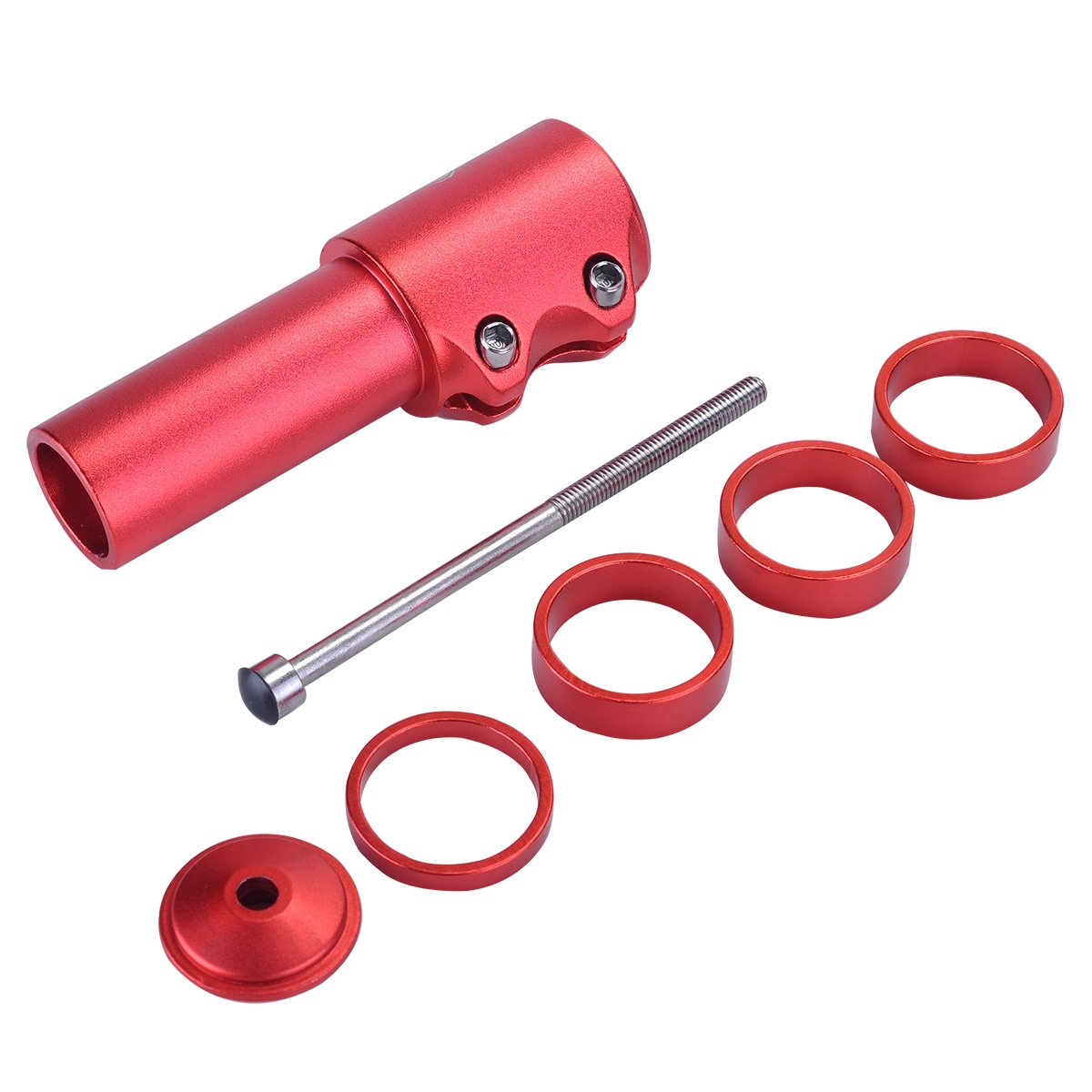
We mourned the lack of standard sizing in the bicycle world: road bikes use centimeters; mountain bikes use inches; some companies just use small, medium, large; how even between bikes that use the same system, two bikes that are the “same size” (such as 58 cm) might fit entirely differently. This isn’t the shop’s fault, it isn’t my fault. It isn’t anybody’s “fault,” really. It’s the result of some manufacturers thinking their way is better and some not caring enough to get it right and probably some unintentional imperfections. But it’s annoying and it shouldn’t cost $1200 to fix.

So I went on Amazon and bought this for $12 instead:


On the one hand, I am incredibly grateful to this LBS for spending time with me, answering all my questions, and in general giving me great service and being very kind to me.

On the other, my neck doesn’t hurt anymore, and it cost me all of $12, much less $65, much less $1200. Does my bike fit perfectly? No, of course not. If I went in and asked to have it fit as is, would they recommend getting “a bike that fits?” Probably, yea. And to be honest, if I worked there as a mechanic, I would probably say the same thing.

It is a shortcoming of bicycles that finding the right one can often be such an ordeal. When you get in a car and the seat isn’t adjusted properly, the solution is… fiddle with the seat until it’s adjusted properly. Nobody ever gave up cars because they tried one that was uncomfortable. Yet when some people get on a bicycle and it’s the wrong size or not adjusted properly, the sad, too-often solution is that they conclude “bicycles are uncomfortable.”

I don’t know that I have a conclusion to this one -- it’s mostly about sharing the ambiguous feelings I have about spending money and a general wish that fitting bikes was less of a black box. I absolutely think it’s worth it to spend a bit more to shop locally (I could, and probably will at some point, detail why doing otherwise often hurts more than helps your wallet). Support your local bike shop. Get a bike that fits -- buy a fit if you have to. But also, sometimes there are drastically more affordable solutions than the ones suggested by professionals with the best of intentions.


2. One with Nature

It goes without saying that when bicycle touring, you spend a lot of time outside. Yet no matter how far you bike, there is always some way (besides the road itself) that we seem to have polluted nature. There’s almost always power lines obscuring your photos, there’s trash in the most random (and sad) places. The two worst perpetrators, in my opinion, are lawns and noise.

Lawns? Yes. Why do we need so much finely mowed green? Because it looks nice? Seriously? There’s three times as much lawn in the US as corn, making it the most irrigated crop in the country. 9 billion gallons of water per day. PER FREAKING DAY. Not to mention the amount of time and gas we spend mowing. We spend more on lawn care than foreign aid.

Don’t get me wrong. I like having a nice, soft bed of grass to lie on as much as the next guy. Chances are if you’re reading this, I’m not talking about your lawn (but do you really use it enough to warrant spending 90 hours a year maintaining it?). There are some huge freaking lawns out there, and I’m sure all the action they get is the mower. Lawn space is nice. But we need a fraction of what we’ve somehow decided is necessary.

Then, there’s the noise. There’s nothing like escaping the city and highway sounds and just hearing wind and nature around you. This happens rarely -- less than ten times in the two or three weeks I’ve been pedaling. Most of the time I hear the low drone of a highway in the distance, as if mother nature is groaning beneath our weight.

And when you do escape the lawns and the noise (which you almost never do), there’s usually trash somewhere.

Cycle touring is many things. It’s been a great way to meet people, gather stories, and see places I wouldn’t otherwise see. It is also an expose into the omnipresence of humankind and our impact on the world. Often, our reach seems inescapable. We have become one with nature.


3. Horns

On a bike, cars communicate with you in various ways. Most pass you with plenty of space -- four or five feet, much more than the legally required three. Some wait behind you if there is oncoming traffic. That’s awesome!

Some honk.

This musing isn’t to slander people that honk. I think, in fact, that it’s usually well intended: “I’m here!” I really think very few people that honk mean, “Get off the road, asshole!”

The problem is that regardless of the intention, it usually scares the living daylights out of me.

If you want to tell me to “get off the road, asshole,” then just roll down your window and do that. It’s less passive aggressive and less dangerous since you’ve slowed down to 12 mph to say it (I can’t hear you if you’re going faster than me). I’ll probably smile and wave, because I almost guarantee I know the bicycle laws better than you. My life depends on it, so I’ve made a conscious decision to be wherever I am in the road, despite the traffic or the presence of a margin or sidewalk (fun fact: riding a bike in the sidewalk is 25x more dangerous than riding a bike in the road. Visibility and predictability are my bets at why). If I’m in the road instead of on the white line, it’s to make you go around me, instead of thinking, “Hey, I can sneak by…” “Sneaking by” is how accidents happen. It’s annoying for both of us -- I’d rather there be a bike lane too! But for both of our safeties, please wait until there’s space (either in the opposing lane or via the appearance of a margin).

If you want to let me know you’re there… thanks, but no thanks. I probably already know you’re there, unless you’re driving an electric vehicle and snuck up on me at 15 mph. If I need to take the lane, I’ll check for cars first.

So whether you mean it maliciously or politely, please just don’t honk. I don’t know what it means and unless your intention is to scare the crap out of me, there are better ways to do it.


4. Dogs

This musing includes some graphic descriptions. If you’re queasy or would rather not see prose made out of tragedy, you can stop reading -- this is the last musing for this blog post so you won’t miss anything else. In short: I saw a dog get hit by a car.

One of the unfortunate and uncontrollable side effects of riding a bike is that dogs love to chase you. Indiana has been the most dogful state so far -- on one day I had at least ten dogs chase after me. Fortunately, almost all of them were stopped by leashes or invisible fences.

If you’re wondering, the best solution to being chased by dogs is to stop moving. This is the process I follow when I hear barking:
  • Find dog.
  • Assess dog: is he or she interested in and able to chase you? If not, continue biking. Else, continue to 3.
  • Brake and dismount on non-dog side.
  • Keep bike between you and the dog. Stop or walk forward until it’s safe to pedal again.
Almost without exception, once you dismount, the dog will immediately become uninterested. It’s almost like you were never there and they’re playing hide-and-go-seek -- “I’m not here!” They realize you’re just a person, and people are, well… uninteresting. I’ve never had a dog continue to chase me once I dismount. Follow me? Yes. Bark at me? Yes. But chase me, as if trying to catch me? No. If they do, that’s why you put the bike between to two of you -- no dog is going to bite a bike.

Unfortunately, not every dog barks.

It was in Indiana when a dog managed to sneak up on me. They have uncanny senses, dogs -- they’ll bark at you from behind houses, cars, bushes, sometimes from a quarter of a mile away. This dog had seen me from behind a bush and had run across the yard and into the road before I knew it was there. I heard the clack-clack of its claws on the pavement and turned my head to see it. I know what I would have done then: without time to stop, I would have had to lift my leg over my bike as it rolled, balancing my weight on the far side as I slowed down so the dog couldn’t bite my ankle. I didn’t have time to think this, though. Whoosh - thud a car drove by, and suddenly there was red in the air, and the smell of blood. The real irony blood smell, that you only smell when there’s been a deep cut.

I heard a yelp, turned my head again, and saw the dog lying in the road. Thankfully, it got up and limped out of the road, whimpering loudly. Dog alive!

I stopped and waited across the road, seeing if anybody would come out of the house. There were no cars in the driveway. I’m not sure what my obligations were at that point. I was, obviously, a little shaken. The car didn’t stop -- I’m not even sure they knew; they probably didn’t even see the dog as it had only popped out of the bush a split second before. It was, I’m sorry to say, probably better that way. Had the dog startled them, they could have instinctively swerved away from it -- and into me.

I felt bad, but I didn’t know what to do. I hope that dog is okay. And I hope they leash it from now on, or put up a fence. I used to have nightmares about terrible things happening to a dog I had once, who often got distracted by moving objects. I wouldn’t wish that on anyone.